









Implementing Measures in Healthcare IT Systems to Ensure Patient Data Security and Build Trust
Originally Posted on healthcare IT Today June 19, 2025
Data, data, and more data — the answer to every question in healthcare. To make any healthcare IT system live up to its full potential, we need lots and lots of data. Your doctor having all of your information the second you walk into your appointment makes your life and the life of your doctors infinitely easier, rather than having to sit down and retell your medical history at the beginning of each appointment. However, in order to achieve this level of ease, you must first establish trust and security. For example, having a password manager remember all of your login information makes your life significantly easier. However, you would not accept the ‘remember me’ option on a public computer at the library or on your coworker’s cellphone like you would on your own devices. This goes doubly so for your sensitive health information. Patients do not trust an organization that is making headlines for a data breach with their information and will instead seek out a different organization.
So, how do we establish that trust and security for our patients? How do we prove that we are a safe place for patients to store their data and receive treatment? We reached out to our brilliant Healthcare IT Today Community to ask — what measures can be implemented in healthcare IT systems to ensure patient data security and build trust regarding the handling of sensitive health information? The following are their answers.
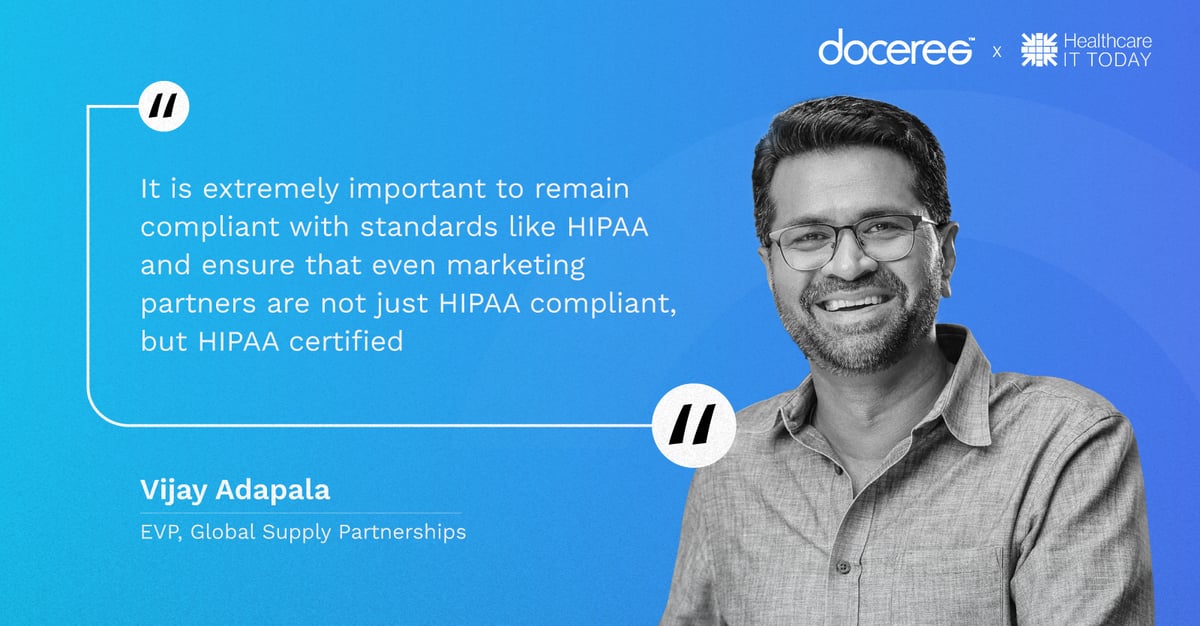
Vijay Adapala, EVP Global Supply Partnerships at Doceree
Ensuring patient data security is very important in fostering trust in healthcare IT systems. To achieve this, robust measures must be prioritized. For example, implementing end-to-end encryption can safeguard data during transmission and storage, while multi-factor authentication should also be used to strengthen access controls and prevent unauthorized entry. Regular security audits and penetration testing should also be used to proactively identify vulnerabilities, ensuring systems remain resilient against evolving threats.
Apart from this, it is also extremely important to remain compliant with standards like HIPAA and ensure that even marketing partners are not just HIPAA compliant, but HIPAA certified. These should be treated as non-negotiable, providing a legal and ethical framework for data protection. Additionally, staff training exercises on cybersecurity should also be undertaken to reduce human error. By integrating these measures, healthcare providers can not only protect sensitive health information but also build confidence among patients, demonstrating a commitment to both innovation and integrity in managing their most personal data
Marlena Herrera, Director, Customer Success at Protegrity
Organizations should implement various measures to ensure patient data security and build trust in their handling of sensitive health information. Strong authentication mechanisms, such as multi-factor authentication (MFA), should be incorporated to ensure that only authorized personnel have access to sensitive patient information. This may involve using passwords, biometric verification, and security tokens.
Protecting patient data both in transit and at rest can significantly reduce the risk of data breaches. Techniques such as robust encryption or tokenization protocols can safeguard sensitive information from unauthorized access and cyber threats.
In addition to technical approaches, organizations can conduct regular security audits to identify potential weaknesses in their IT infrastructure and processes. These audits should be performed by qualified security professionals who can recommend necessary updates and improvements based on their findings, and continuous monitoring for unexpected behavior can also be implemented. Educating healthcare staff about data security and best practices is another non-technical approach that should be utilized. Regular training sessions can help employees recognize and respond to potential security threats, such as phishing attacks.
Lastly, organizations can enhance their handling of sensitive patient healthcare data by increasing compliance with regulations. Adhering to relevant regulations and standards, such as the Health Insurance Portability and Accountability Act (HIPAA), ensures that healthcare organizations follow best practices for data security. Compliance with these regulations can also foster trust with patients regarding the handling of sensitive health information.
Anand Naik, Co-Founder and CEO at Sequretek
Trust in healthcare hinges on how well patient data is protected, requiring a multi-layered security strategy built on zero-trust architecture (ZTA). This approach ensures that every access request is verified through multi-factor authentication (MFA), behavioral analytics, and continuous monitoring. End-to-end encryption protects patient data both at rest and in transit, while AI-driven anomaly detection helps identify and mitigate threats before they increase.
Beyond technology, transparency is essential, healthcare organizations must communicate how data is collected, stored, and shared while offering secure patient portals with customizable privacy settings to give patients greater control. Compliance with HIPAA and other regulations sets a boundary, but proactive cybersecurity measures are necessary to address evolving threats. A seamless patient experience depends on convenience and on ensuring that every digital interaction remains secure, private, and trustworthy.
Linda Perryclear, Senior Director, Product at Availity
For many years, healthcare providers and organizations have had patient safety programs. We are now in an age where we must put the same focus and effort into our patient data security programs. With these programs, I would say that it’s important to lead with trust. And the way to do that is through transparency –communicate your security practices. On your organization’s website, in waiting rooms, anywhere you are treating your patients – share your security practices. Then make sure you have the measures and systems in place to ensure patient data security, including data encryption, regular security assessments of staff and technology, and backup and disaster plans.
Matt Ernst, VP, Technical Operations and Support at Tendo
To ensure patient data security and build trust in the handling of sensitive health information, healthcare IT systems must implement robust security measures, including end-to-end encryption, secure user authentication, and role-based access control to limit who can access data. Regular audits and vulnerability assessments should be conducted to identify and address any potential security gaps.
Additionally, healthcare organizations should not only meet but also exceed security protocols by implementing ongoing testing from third-party experts. This ensures that security systems are continuously evaluated and updated to stay ahead of emerging threats. Compliance with industry standards, such as HIPAA and SOC 2, should be maintained and regularly reviewed. Building transparency around these security practices and providing patients with clear information on how their data is being protected can further strengthen trust and confidence in the system.
Gabe Stapleton, Vice President Security and Enterprise Technology, CISO at Strive Health
Adopting a comprehensive compliance framework that includes auditing against HIPAA regulations, such as HITRUST, is the first step in demonstrating to our partners and patients that their sensitive data is secure. However, compliance alone isn’t enough. Building a strong security culture, implementing modern security practices, and prioritizing patient safety are essential to reinforcing trust. Layering our security and compliance measures while ensuring seamless business operations and patient care, we strengthen confidence in our ability to protect sensitive health information.
Bhushan Patel, Senior Member at IEEE
Ensuring patient data security and building trust in healthcare IT systems demands a multifaceted approach that goes beyond technical safeguards to address organizational culture, patient transparency, and proactive governance. The integration of advanced AI-driven threat detection systems, coupled with the adoption of blockchain for secure data transactions, represents a transformative shift in healthcare IT. For Example, Blockchain can create an immutable ledger of patient data access, ensuring traceability and accountability, which is especially critical in complex ecosystems like surgical robotics or wearable health devices. However, these measures alone are insufficient without fostering patient trust.
Organizations must prioritize transparent communication by offering patients intuitive dashboards that allow them to see, control, and even revoke access to their personal health data. A feature particularly impactful for wearable technologies that track real-time metrics. Furthermore, addressing third-party vulnerabilities in interconnected systems, such as when wearable devices sync with EHRs, requires stricter vendor audits and enforceable compliance contracts. Moreover, a privacy-first culture must permeate every layer of the organization. Staff need regular simulations and training to address the human element of data security, which remains the most significant vulnerability in any system
Nick Orser, GM, Healthcare at Verato
Security and trust start with accurate identity — making sure all patient data is associated with the right patients, and that the right verification and governance controls are in place to access that data. How can a patient trust you with their data when their portal is missing their lab work or imaging? Or worse, when it contains another patient’s lab work and imaging? Ensuring you solve the problem that drives everything else — knowing who is who — is the foundation of building this patient trust. And that foundation requires organizations to implement healthcare master data management solutions to gain even deeper identity intelligence for every patient.
Jay Adcock, Chief Information Security Officer at AdhereHealth
Ensuring patient data security is fundamental to building trust, and without trust, engagement suffers. Healthcare IT systems must go beyond basic compliance to proactively protect sensitive health information.
Robust encryption, multi-factor authentication, continuous monitoring, and training are critical safeguards against unauthorized access and breaches. Equally important is transparency—patients need clear, accessible information about how their data is used and protected. Ethical data stewardship, secure integrations, and adherence to rigorous regulatory frameworks help reinforce confidence in the system.
Ultimately, trust is earned through both action and communication. Healthcare organizations must continuously evolve security protections, educate patients, and ensure data is used responsibly to improve care while safeguarding privacy.
Jon Moore, Chief Risk Officer and Senior VP of Consulting Services at Clearwater Security
To ensure patient data security and build trust in healthcare IT systems, organizations should implement a robust security program grounded in recognized frameworks like the NIST Cybersecurity Framework and the 405(d) Health Industry Cybersecurity Practices (HICP). This involves understanding risks at both the system and component levels through detailed risk analysis, then effectively managing those risks with tailored controls such as encryption, access management, and continuous monitoring.
By aligning with these established practices, healthcare providers can safeguard sensitive health information while demonstrating a commitment to accountability. Communicating these efforts to patients, through clear, accessible explanations of security measures, further reinforces trust in how their data is handled.
Andy Gostine, Co-Founder and CEO at Artisight
Robust patient data security begins with rigorous access controls. Healthcare organizations must implement multi-layered authentication systems that ensure only authorized personnel can access sensitive health information. This isn’t just about password protection—it’s about developing adaptive security frameworks that verify identity through multiple factors, track access patterns, and flag anomalous behavior. By embedding these safeguards directly into the technology architecture, we create systems where protection isn’t an afterthought but a foundational element.
The trust patients place in us to safeguard their most personal information demands nothing less than this level of diligence. When healthcare providers can confidently tell patients exactly who has access to their data and why, we build the transparency that forms the cornerstone of trust in modern healthcare technology.
Rhonda Gibler, Chief Growth Officer at Carenet Health
Ensuring patient data security requires a multi-layered approach. This starts with adopting cloud-based systems equipped with end-to-end encryption, robust authentication protocols, rigorous testing, and continuous monitoring. Patients need to be informed about how their data is used, stored, and protected; much of that data needs to be interoperable and also portable (available to patients themselves). Regular audits, adherence to regulatory frameworks, and clear communication are essential in reinforcing the trust between healthcare organizations and patients. The companies that successfully implement these measures position themselves as sustainable and responsible partners in care, bolstering patient confidence and loyalty.