
Q&A with Kamya Elawadhi, Co-Founder and President of Doceree
Originally Posted on CityBiz , May 21 2026
Kamya Elawadhi is the Co-Founder and President of Doceree — a company that is redefining the infrastructure behind healthcare marketing through AI, workflow automation, and physician-focused engagement systems. Since launching the business, she has helped position Doceree at the intersection of healthcare data, commercial operations, and AI-powered marketing technology.
In this conversation, Elawadhi discusses building a company inside one of healthcare’s most fragmented technology environments, why pharma marketing has lagged behind other industries, and how Doceree is positioning AI as operational infrastructure rather than branding language.
Before Doceree, you were working in a very different world. What was the specific moment — or frustration — that made you think, ‘this is broken, and I can fix it’?
It wasn’t one moment, but a pattern I couldn’t unsee. I’d come from industries where marketing had already become granular, behavioral, and accountable. Healthcare was running on systems that felt a decade behind — fragmented stacks, slow loops, almost no understanding of how a physician actually engages with information.
What clicked for me was realizing this wasn’t a technology gap. It was a missing layer of infrastructure. Other industries had rebuilt their engagement foundations; healthcare had bolted on tools. And if physician communication is one of the most consequential channels in the world, why was it running on workflows nobody had redesigned?
That question became Doceree.
Co-founding a company is one thing. Co-founding one in healthcare, in a space no one had clearly defined yet, is another. What did those first two years actually look like?
Slower than we wanted. And louder.
We weren’t only building a company; we were trying to give a category a name. In healthcare, you don’t earn the right to sell innovation until you’ve earned the right to be trusted. That took longer than any of our investor decks accounted for.
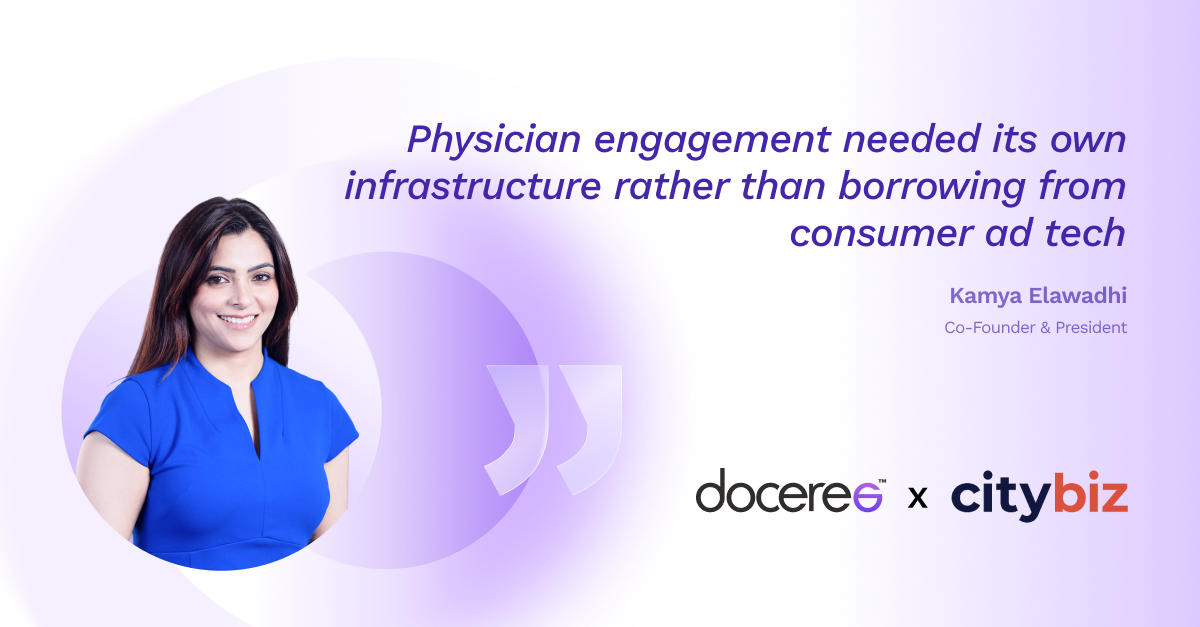
A lot of those early conversations weren’t sales calls — they were education sessions, explaining why physician engagement needed its own infrastructure rather than borrowing from consumer ad tech. We got pushback. We changed our minds about things we thought were settled. We rebuilt the pitch more times than I can count.
What kept the team going was that every honest conversation with a brand, a publisher, or a physician reinforced the same thing: the industry knew the system was broken. It just hadn’t seen a credible alternative yet. That gap was our opportunity — and our two-year apprenticeship.
The title of President at a founder-led company means something different at every company. How do you personally define what you own — and what you deliberately don’t?
My role is direction, ambition, and tempo. Not control.
That distinction matters more than the title. In a founder-led company, the temptation is to believe leadership scales with how many decisions sit on your desk. It doesn’t. It scales with how many decisions other people are confident enough to make without you.
So I own where the business is going, what we say no to, and the culture that determines how we work. I deliberately don’t own the day-to-day calls inside functions where stronger operators than me already exist. Health Decode: The Makers Summit 2026 is a good example — we built it as a platform where strategists, technologists, creators and future leaders could shape the conversation alongside us, rather than receive it from us.
I’ll add one thing, as a woman in this seat: authority doesn’t need to look rigid to be effective. The strongest companies I’ve seen are ones where people trust themselves enough to lead from wherever they sit. That can’t happen if one voice — even the founder’s — is the only signal in the room.
Pharma marketing has been running on a fragmented stack of tools for over two decades. Why has it taken this long for the industry to demand something better?
Because the industry was never punished for tolerating it.
Healthcare marketing optimized around channels, compliance gates, and isolated tools because the inefficiency was hidden — each function had its own platform, its own data, its own reporting. The cost of all that disconnection was real, but it was distributed. No single team was held accountable for it.
What’s changed is that physicians don’t experience engagement the way the back-end is built. They expect the same fluency they get from every other digital surface in their lives. AI has accelerated that gap from inconvenient to untenable.
The conversation has finally moved from “which tools do we need?” to “what should this whole thing run on?” That’s a different question. It’s also why initiatives like Daily Command exist now and didn’t five years ago.
You’ve built a business that sits at the intersection of healthcare data, AI, and commercial marketing. How do you hold all three of those worlds together without losing the thread?
By not treating them as three separate things.
When we started Doceree, I never saw data, AI, and marketing as parallel businesses to balance. They were three faces of the same broken system. Brand teams couldn’t make better calls because the data was siloed. The data was siloed because the workflows weren’t designed for it. And the workflows weren’t designed for it because nobody had asked what a physician’s experience should actually feel like on the other end.
That single insight has shaped every product — RepTwin, Co-Pay.com, Daily Command — but the thread isn’t the product list. It’s the principle: build technology that feels smart without losing the human context healthcare depends on. Once that’s the bar, what looks like three worlds collapses into one.
There is a version of AI in healthcare that is all promise and no delivery. What separates the real from the noise — and how do you make sure Doceree stays on the right side of that line?
The test is simple: does the technology actually change how people work?
A lot of companies are layering AI on top of broken workflows and calling that transformation. It isn’t. If the underlying system is still slow, still reactive, still hard to navigate, AI just becomes a more expensive coat of paint. That’s innovation theater, and healthcare has had enough of it.We’ve always tried to treat AI as an operational layer rather than a feature layer. Whether it’s RepTwin handling continuous physician engagement, Daily Command pulling visibility together for brand teams, or the broader stack removing friction from how marketers actually move through their day, the question we keep asking is whether the work itself feels different on the other side.
Healthcare is too regulated and too consequential for AI as branding. The industry doesn’t need promises. It needs systems that hold up on a Tuesday afternoon at 4pm when somebody’s trying to get something done.
Daily Command was co-built with 75 senior pharma leaders over a quarter. Most enterprise software is built by engineers and sold to operators. Why did you flip that model — and what did you learn from doing it?
Because the alternative had a poor track record.
Healthcare marketing has spent two decades using software that was built on assumptions about how teams work and then sold to teams that worked differently. The result is what you’d expect — adoption fatigue, shelf-ware, and workflows people quietly route around. We didn’t want to build something else and then go convince the industry to bend toward it.
So we inverted the order. The 75 leaders who shaped Daily Command weren’t focus-grouped at the end of the build; they were in the room from the first sketch. Health Decode was the structure that made that possible. Once people stopped being asked what features they wanted and started being asked what their actual day looked like, the conversation shifted entirely — to friction, to decision fatigue, to the blind spots they’d grown to live with.
The takeaway was almost embarrassingly obvious: people don’t want more dashboards. They want fewer reasons to open them. You only learn that by building with operators, not for them.
When 75 people are in the room co-building something, disagreement is inevitable. What was the hardest thing the group couldn’t agree on — and how did you resolve it?
Simplicity. Which sounds like it shouldn’t be a fight, but it was the loudest one.
Everyone agreed the current state was too complex. The question was whether a modern platform should expose that complexity in a more usable form or strip it out entirely. Some leaders wanted deeper control and customization, because their workflows had earned it. Others wanted the system to absorb the noise and just surface the next call worth making.
What unlocked the room wasn’t a vote. It was reframing the question around outcome. Does this help a team move faster on the right call without adding to their load? Once that became the test, the design choices flowed from it.
Honestly, the disagreement wasn’t a problem. It was the product insight.
The promise is one login, one workflow, the full picture. But pharma brand teams are notoriously protective of their existing tools and relationships. How do you win that trust?
You don’t win trust in healthcare by asking teams to throw out what they’ve already invested in.
Pharma teams protect their existing stack for good reasons. Those workflows were built around compliance requirements, stakeholder relationships, and operational scars from past rollouts that didn’t go well. Walking in and saying “use this instead” is the fastest way to lose the room.
What earns trust is showing that the new system understands the old one. Daily Command was never positioned as a replacement layer. It was built to sit across what teams already use — adding visibility, clarity, and a way to act faster without forcing anyone to start over.
The shift happens when a team realizes the platform isn’t asking them to change their job. It’s asking them to spend less of it managing software.
You’re going into closed beta in June, full release July 14. What does success look like for you twelve months from now — and what would tell you that Daily Command has truly changed how pharma brand teams work?
Not adoption. Behavior.
Adoption is a vanity metric. A team can log into something every day and still be doing the same fragmented work underneath. What I want to see twelve months from now is a different shape of week — fewer hours spent reconciling updates, fewer reactive meetings, more time on strategy instead of system management.
The goal was never to add another interface to the stack. It was to give pharma brand teams a way to manage complexity without becoming the complexity.
The strongest signal will be a quiet one: teams forgetting what their workflow used to look like, and wondering how they ever worked without it. When a product slips into the background like that, you know it’s stopped being software and started becoming infrastructure.
Doceree started in healthcare marketing. Where does the company’s ambition end — or does it?
It doesn’t.
Healthcare marketing was the entry point, not the ceiling. We chose it because the friction there was visible and the case for change was strongest. But once you start solving for how intelligence, workflow, and coordination come together inside healthcare, you can see the same gaps almost everywhere — across commercial, medical affairs, payer engagement, clinical communication.
The longer-term ambition is to help build the operating layer healthcare has been missing for decades. Something that makes how the industry engages, decides, and collaborates feel adaptive rather than inherited. That’s a much bigger surface area than marketing alone, and we’re only at the early part of that arc.
What’s the one thing about where healthcare marketing is going that you don’t think enough people are paying attention to yet?
That it’s quietly stopping being marketing.
For two decades the industry organized itself around campaigns, channels, and impressions. The transformation now is about the layer underneath — how brand teams sense what’s happening, decide what to do about it, and coordinate the response. That’s closer to operations than promotion. Most people are still treating it as the latter.
The other thing nobody is pricing in: physician expectations are moving faster than the industry assumes. Doctors live in highly responsive digital environments outside healthcare. Eventually they’ll expect the engagement healthcare sends them to feel the same. The companies preparing for that now will define the next decade. The ones still optimizing campaigns will spend it catching up.